Animal Farm by George Orwell
- Meggy Grosfeld
- Mar 18
- 3 min read
Updated: Mar 25
I’ve been thinking about starting to read more banned books so I can dedicate one of the shelves in my room as a “Banned Bookshelf.” I read 1984 by George Orwell in high school, either sophomore or junior year, and it was one of my favorite books I’ve ever read for class. So when I was in The Strand the other week and saw Animal Farm on the banned books table, I felt like I had to pick it up, especially since I never got the chance to study it in school.

All animals are equal but some are more equal than others…
This book was so fun to read, not because of an exciting, adventurous plot, but because of how outrageous it is. Yes, pigs are getting drunk and walking around on two legs, but the real absurdity comes from what it reveals: what happens when people, or animals, in this case, are given absolute power and run a totalitarian regime.
Encouraged to rebel against their human master’s way of life, the farm animals—goats, horses, chickens, and pigs, decide to overthrow the farm and adopt Animalism, turning Jones’s Farm into Animal Farm. Independently and solely run by the animals, particularly the pigs leading the revolution, a power-hungry pig, Napoleon, rises as a dictator, forming a ruling class behind him while they brainwash the working class into blindly following their rule.
It’s such a smart use of allegory, using animals to expose and critique the political tactics of totalitarianism, making complex and often uncomfortable truths impossible to ignore. I was especially struck by the satirical nature of his writing and how, over time, the pigs, particularly Napoleon, gradually morph into the very thing that once held all the power on the farm: humans. He uses propaganda, creating fear and chaos among the animals to get his way, echoing patterns that feel familiar across many moments in history, as Orwell intended.
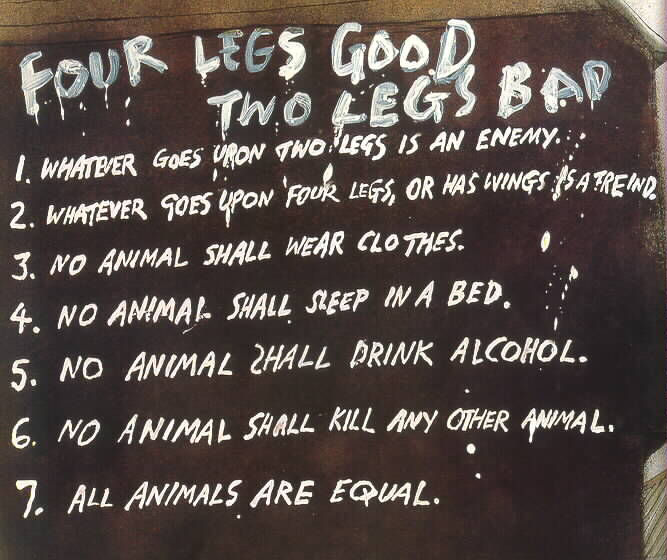
Napoleon becomes even worse than the humans who once ran the farm. His character is selfish, cruel, and calculating, as he amends and rewrites the commandments that once adhered to Animalism to benefit his own needs and those of his inner circle.
It’s such a smart use of allegory, using animals to expose and critique the political tactics of totalitarianism, making complex and often uncomfortable truths impossible to ignore.
Speaking of his inner circle, Squealer serves as Napoleon’s personal propagandist. He seems to be everywhere and nowhere on the farm, either tucked away in the farmhouse or loyal and eager to defend Napoleon. Whenever Napoleon’s actions are questioned, Squealer suddenly appears, ready to justify and manipulate the other animals into believing that Napoleon’s actions stem from genuine concern and care for the working class.
Once the pigs started raiding the liquor cabinet, I knew it was too far gone.
RIP Snowball, he didn’t technically die, but he was banished from the farm once he started to fall out of line with Napoleon’s ideology. As the more intellectual of the pigs, with his ability to read and write, he serves as a more noble character, whose efforts on the farm are more focused on progress and the collective good. He shares his knowledge with the less intelligent animals, especially the goats, teaching them basic reading skills, and his work on building the windmill is driven by a desire to help reduce the animals’ labor. But because he was so intelligent and his ideas threatened Napoleon’s authority, Napoleon’s harsh leadership ultimately prevailed.

I thought this book achieved so much in so few pages. It truly is an evergreen story, still deeply relevant today and reflective of the fucked up country we live in. Even the animals of the working class, like Boxer, are such important characters in the story. He works day in and day out, never gets recognized for his efforts, and is never given a break. He works tirelessly until his hooves and legs give out, is forced to retire at an unfairly old age, and before he can retire, he slowly begins to catch on to the corrupt system that has become the norm, only to be sent to his death under false pretense. Sounding more and more familiar as I type these words on the page.
Seriously, this book is a 10/10 for me. George Orwell is one hell of a writer, creating such lovable and hateable characters that linger in my mind long after I’ve closed the book.


